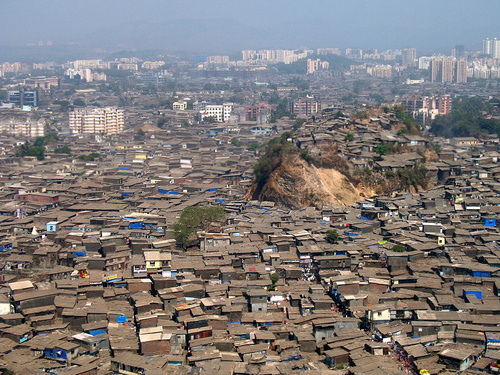
Dharavi, often described as the largest slum in Asia, is a 427 acre triangular stretch of land in central Mumbai, housing more than 600,000 slum dwellers; the unofficial number can go near a million. It is a conglomeration of continuous settlements, separated by a small road or sometimes a wall - constructed hastily at times of conflict. Dharavi is literally sandwiched between the Western and Central suburban railway lines with Mahim and Bandra to its west, Mithi River to the north and Sion and Matunga to its east and south respectively. Mahim, Matunga and Sion railway stations mark its three corners. Dharavi has had settlements since the beginning of the 18th century, which comprised Kolis or the fisher folk, who lived at the edge of the creek that came in from the Arabian Sea. The Gazetteer of Bombay City and Island in 1909 had mentioned Dharavi as one of the 'six great Koliwadas of Bombay'. It is thought that the present day Dharavi also includes the land obtained by the accidental drying up of the creek that happened over a period of time.
Of the 10 million people living in the mega city Mumbai, 6 million (60%) are living in the slums, many of them living in Dharavi itself.
TheGovernment:
The government of Mumbai are trying to clear the slums but the problem is slum dwellers like where they are, and don’t want to move. For many of them, they haven’t known any other home, it’s what they are used, what they think home is. They don’t want to move because they have communities they don’t want to leave.
The government are offering land developersfree land on a deal. If they can offer the slum dwellers living on the land somewhere to call home they can do what they like with the slums. However this is a difficult thing to do because of the slum dwellers who won’t move out.
The first settlers in Dharavi came there over 300 years ago, and turned marshland into liveable land; today Dharavi is home to over 500,000 people of all religions, castes and economic strata, not just the 'poor'.
Almost none of the people who live in Dharavi own the land, but a great many own their homes and businesses (some of which they rent out); many houses have electricity which they pay for, and some have running water.
Nevertheless, infrastructure is poor: few residents have toilets in their homes; open sewer lines spread disease and are a health hazard in the monsoon.
Home to thousands of industries, including leather, pottery, textiles, food production and now a major hub of recycling, there is over US $600 million of turnover; unfortunately some of these industries pollute the environment and are unsafe for workers.
The current redevelopment plan will give slum dwellers who own their structure a new 300 sq ft flat in Dharavi for free; those who rent will have to go elsewhere. Business owners will receive 250 sq ft, and will have to pay for anything more than that.
The redevelopment has been divided into five sectors, which developers will bid for in a competitive process. Developers need to build housing for slum residents, and they will also
be able to build more lucrative residential buildings and commercial properties.
On March the 11th of 2011, a magnitude 9 earthquake shook Japan.
This was felt from Norway through to Antarctica.
Tsunami debris continues to wash up on North American beaches to this day.
Fukushima Power plant suffered a level 7 nuclear meltdown after the tsunami.
Two years after the quake, 300 000 people are still living in temporary homes because they lost theirs.
The earthquake only lasted 5 minutes but caused so much damage.
The tsunami only happened 20 minutes later so people had little time to escape with their lives even with a warning system.
The tsunami went over the 10m wall in Japan because some of it sunk into the ground because there was so much pressure.
The unexpected disaster was neither the largest nor deadliest earthquake and tsunami to strike this century. That record goes to the 2004 Banda-Aceh earthquake
and tsunami in Sumatra, a magnitude-9.1, which killed more than 230,000
people. But Japan's one-two punch proved especially devastating for the
earthquake-savvy country, because few scientists had predicted the
country would experience such a large earthquake and tsunami.
Japan's scientists had predicted a smaller earthquake would strike the
northern region of Honshu, the country's main island. Nor did they
expect such a large tsunami. But there had been hints of the disaster to
come. The areas flooded in 2011 closely matched those of a tsunami that
hit Sendai in 869. In the decade before the 2011 Tohoku earthquake, a
handful of Japanese geologists had begun to recognize that a large
earthquake and tsunami had struck the northern Honshu region in 869.
However, their warnings went unheeded by officials responsible for the country's earthquake hazard assessments.
Now, tsunami experts from around the world have been asked to assess
the history of past tsunamis in Japan, to better predict the country's
future earthquake risk.
The cause
The 2011 Tohoku earthquake struck offshore of Japan, along a subduction zone
where two of Earth's tectonic plates collide. In a subduction zone, one
plate slides beneath another into the mantle, the hotter layer beneath
the crust. The great plates stick and slip, causing earthquakes. East of
Japan, the Pacific plate dives beneath the overriding Eurasian plate.
The temblor completely released centuries of built up stress between the two tectonic plates, a recent study found.
The earthquake started on a Friday at 2:46 p.m. local time (5:46 a.m.
UTC). It was centered on the seafloor 45 miles (72 kilometers) east of
Tohoku, at a depth of 20 miles (32 km) below the surface. The shaking
lasted about six minutes.
- See more at: http://www.livescience.com/39110-japan-2011-earthquake-tsunami-facts.html#sthash.zyKtaEfU.dpuf
More than 1,000 aftershocks hit Japan after the earthquake, the largest a magnitude 9.
About 250 miles of Japan's main island of Honshu moved eastward by 8 feet from the jolt.
The Pacific plate slid westward near the epicenter by 79 feet.
The tsunami broke Icebergs off the Sulzberger Ice shelf in Antarctica.
It happened at 12:46 and killed 19,000 people.
Areas as far away as Chile and the USA reported a tsunami surge over 6 feet.
By the time the tsunami reached Hawaii it was so small.
The unexpected disaster was neither the largest nor deadliest earthquake and tsunami to strike this century. That record goes to the 2004 Banda-Aceh earthquake
and tsunami in Sumatra, a magnitude-9.1, which killed more than 230,000
people. But Japan's one-two punch proved especially devastating for the
earthquake-savvy country, because few scientists had predicted the
country would experience such a large earthquake and tsunami.
Japan's scientists had predicted a smaller earthquake would strike the
northern region of Honshu, the country's main island. Nor did they
expect such a large tsunami. But there had been hints of the disaster to
come. The areas flooded in 2011 closely matched those of a tsunami that
hit Sendai in 869. In the decade before the 2011 Tohoku earthquake, a
handful of Japanese geologists had begun to recognize that a large
earthquake and tsunami had struck the northern Honshu region in 869.
However, their warnings went unheeded by officials responsible for the country's earthquake hazard assessments.
Now, tsunami experts from around the world have been asked to assess
the history of past tsunamis in Japan, to better predict the country's
future earthquake risk.
The cause
The 2011 Tohoku earthquake struck offshore of Japan, along a subduction zone
where two of Earth's tectonic plates collide. In a subduction zone, one
plate slides beneath another into the mantle, the hotter layer beneath
the crust. The great plates stick and slip, causing earthquakes. East of
Japan, the Pacific plate dives beneath the overriding Eurasian plate.
The temblor completely released centuries of built up stress between the two tectonic plates, a recent study found.
The earthquake started on a Friday at 2:46 p.m. local time (5:46 a.m.
UTC). It was centered on the seafloor 45 miles (72 kilometers) east of
Tohoku, at a depth of 20 miles (32 km) below the surface. The shaking
lasted about six minutes.
- See more at: http://www.livescience.com/39110-japan-2011-earthquake-tsunami-facts.html#sthash.zyKtaEfU.dpuf
In Japan, residents are still recovering from the disaster. Radioactive water was recently discovered leaking from the Fukushima Daiichi Nuclear Power Plant, which suffered a level 7 nuclear meltdown after the tsunami.
Japan relies on nuclear power, and many of the country's nuclear
reactors remain closed because of stricter seismic safety standards
since the earthquake. Two years after the quake, about 300,000 people
who lost their homes were still living in temporary housing, the
Japanese government said.
- See more at:
http://www.livescience.com/39110-japan-2011-earthquake-tsunami-facts.html#sthash.RfkwIkLG.dpuf
In Japan, residents are still recovering from the disaster. Radioactive water was recently discovered leaking from the Fukushima Daiichi Nuclear Power Plant, which suffered a level 7 nuclear meltdown after the tsunami.
Japan relies on nuclear power, and many of the country's nuclear
reactors remain closed because of stricter seismic safety standards
since the earthquake. Two years after the quake, about 300,000 people
who lost their homes were still living in temporary housing, the
Japanese government said.
- See more at:
http://www.livescience.com/39110-japan-2011-earthquake-tsunami-facts.html#sthash.RfkwIkLG.dpuf
On March 11, 2011, a magnitude-9 earthquake shook northeastern Japan, unleashing a savage tsunami.
The effects of the great earthquake were felt around the world, from Norway's fjords to Antarctica's ice sheet. Tsunami debris continues to wash up on North American beaches two years later.
- See more at: http://www.livescience.com/39110-japan-2011-earthquake-tsunami-facts.html#sthash.RfkwIkLG.dpuf
this
hh
On March 11, 2011, a magnitude-9 earthquake shook northeastern Japan, unleashing a savage tsunami.
The effects of the great earthquake
were felt around the world, from Norway's fjords to Antarctica's ice
sheet. Tsunami debris continues to wash up on North American beaches two
years later.
- See more at: http://www.livescience.com/39110-japan-2011-earthquake-tsunami-facts.html#sthash.VmWjcwso.dpuf
On March 11, 2011, a magnitude-9 earthquake shook northeastern Japan, unleashing a savage tsunami.
The effects of the great earthquake
were felt around the world, from Norway's fjords to Antarctica's ice
sheet. Tsunami debris continues to wash up on North American beaches two
years later.
- See more at: http://www.livescience.com/39110-japan-2011-earthquake-tsunami-facts.html#sthash.VmWjcwso.dpuf